


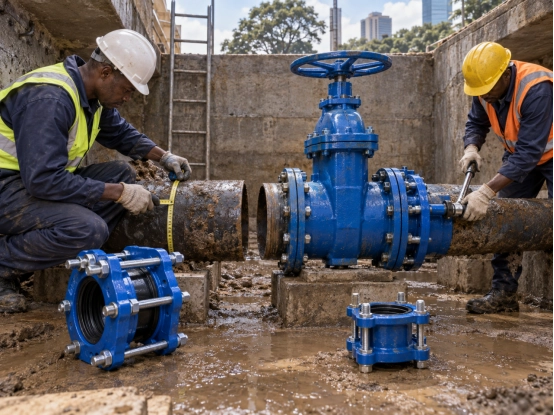
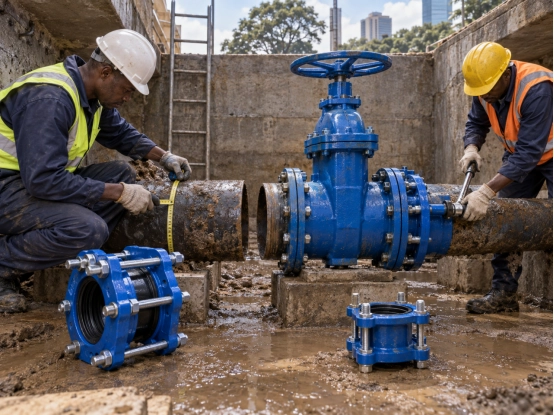
In Nairobi, an aging water-network valve chamber presents a problem. The replacement valve matches the schedule, but buried pipe has shifted and flange faces no longer align. The shutdown clock is running.
Choosing between adjustable and quick flange adaptors is a field decision. Actual dimensions and installation tolerance determine the answer. For UK‑based water‑network refurbishment jobs, specify Conflex WRAS‑approved flange adaptors to satisfy local drinking‑water regulatory standards.
Quick Answer: Adjustable or Quick Flange Adaptor?
Choose an adjustable flange adaptor when dimensions or alignment may vary. It provides a defined adjustment range.
Choose a quick flange adaptor when the pipe OD and flange details are confirmed. It reduces assembly time.
Neither design is automatically better.
| Project Condition | Recommended Option | WRAS Compliance Note |
| Variable pipe OD or alignment uncertainty | Adjustable flange adaptor | Conflex adjustable flange adaptor is WRAS‑approved for potable‑water applications |
| Standardised pipe dimensions | Quick flange adaptor | Conflex quick flange adaptor is WRAS‑certified for PE / PVC drinking‑water pipelines |
| Limited installation time | Quick flange adaptor, if dimensions are verified | WRAS‑approved Conflex quick adaptor reduces site assembly hours |
| Difficult field conditions | Adjustable flange adaptor | WRAS‑approved Conflex adjustable adaptor accommodates site dimensional deviations |
| Valve or pump connection | Either, subject to flange and pressure verification | Both Conflex ranges hold full WRAS approval for potable‑water service |
What Is an Adjustable Flange Adaptor?
An adjustable flange adaptor connects a plain-ended pipe to flanged equipment while allowing controlled adjustment. It may accommodate insertion length or minor dimensional variation. The drawing matters more than the name.
During valve replacement, the crew may find a settled pipe or an incorrect face-to-face record. Check the permitted range before ordering. Conflex’s flange adjustable adaptor for PE pipe is WRAS‑approved; always match dimensions and pressure ratings to your pipeline.
When Is an Adjustable Design Most Useful?
Adjustable designs suit existing networks, valve chamber refurbishment and mixed-material connections. They help where access is awkward.
For PE, measure the outside diameter rather than relying on nominal size. Conflex’s flange adjustable adaptor for PE pipe suits projects needing field tolerance. Match its dimensions and pressure limits to the line.
What Is a Quick Flange Adaptor?
A quick flange adaptor is intended to make a known connection quickly. It suits standardised pipework where OD, flange drilling and connection length are checked.
During planned maintenance, the correct adaptor and gasket make assembly predictable.
Quick does not mean measurement-free. Pipe OD, flange pattern and pressure ratings must match.
Key Differences Between Adjustable and Quick Flange Adaptors
The decision becomes clearer when the designs are compared against actual site constraints.
| Fattore di selezione | Adjustable Flange Adaptor | Quick Flange Adaptor |
| Installation flexibility | Higher within the stated range | More limited |
| Field adjustment | Available within design limits | Usually requires accurate pre-measurement |
| Installation speed | Moderato | Usually faster |
| Best for | Irregular or uncertain site conditions | Standardised and time-sensitive projects |
| Pipe alignment tolerance | More forgiving within design limits | Requires better alignment |
| Procurement planning | Useful when dimensions may change | Best when specifications are fixed |
| Main selection risk | Exceeding the adjustment range | Misalignment or sealing problems |
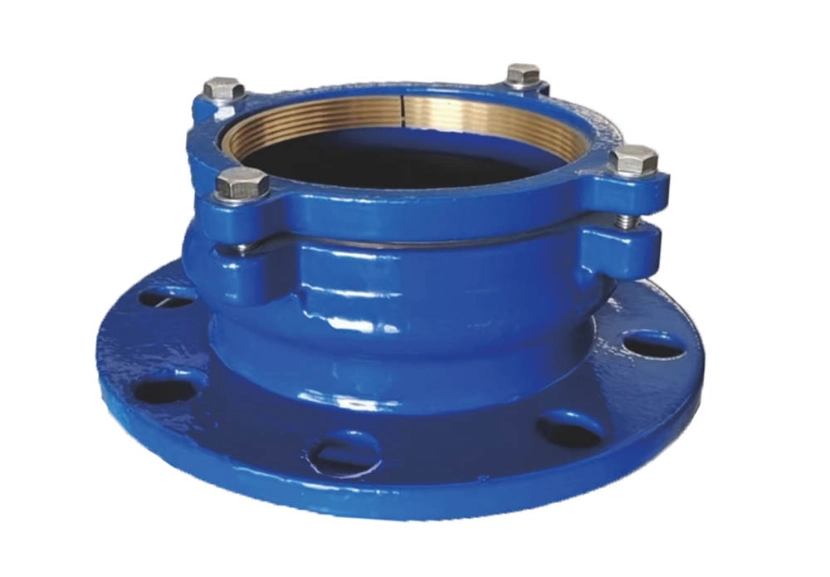
1. Alignment and Dimensional Tolerance
Measure the actual OD and distance to the flange face. Check alignment and bolt clearance. Adjustable adaptors cannot correct an unsupported or badly misaligned pipe.
2. Installation Speed and Shutdown Time
Quick adaptors suit narrow shutdown windows. Yet an adjustable adaptor may avoid cutting and re-measuring during an old valve replacement.
3. Pressure, Restraint and Operating Conditions
Check both designs against working pressure, test pressure and expected movement. A flange adaptor is not automatically restrained. Axial thrust develops at bends, dead ends and valves. The system may need a adattatore universale a flangia vincolata, thrust blocks or another restraint arrangement. Fluid and corrosion exposure also matter.
Which Flange Adaptor Should You Use in Different Field Scenarios?
The useful choice depends on the job rather than the label on the box.
Scenario 1: New PE Pipeline with Confirmed Dimensions
A quick flange adaptor suits PE lines when OD, flange drilling and pressure class are fixed in approved drawings. It fits repeated valve connections.
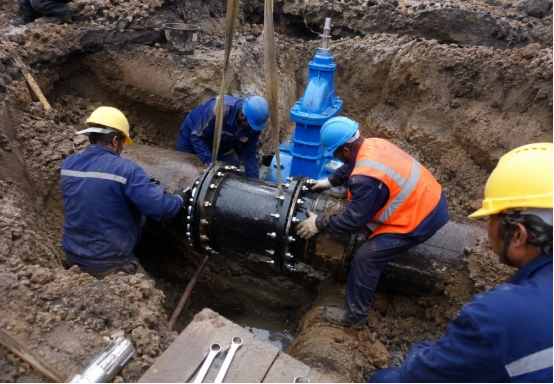
Scenario 2: Valve Replacement in an Existing Water Network
An adjustable flange adaptor may reduce risk when the existing pipe has moved or records are incomplete. Measure the exposed pipe and compare the adjustment with the required dimension.
Scenario 3: Emergency Repair with Limited Shutdown Time
Use a quick adaptor when the size is known and the repair kit is complete. If the field condition is uncertain, adjustable capacity may be more useful.
Scenario 4: Confined Valve Chamber or Pump Station
Compare adaptor length, bolt access and tool clearance. A compact quick adaptor suits planned work. Adjustment may be worth more where pipe movement has occurred.
Installation and Quality-Control Checklist
Select and install the adaptor as one process. Use this checklist in the site method statement.
Before Installation
- Measure the actual pipe outside diameter.
- Confirm pipe material and pipe-end condition.
- Check flange standard and bolt-hole pattern.
- Verify working and test pressure.
- Confirm the required adjustment or insertion length.
- Inspect the gasket, bolts and adaptor components.
During Installation
- Clean the pipe surface and remove loose coating or debris.
- Position the gasket evenly.
- Keep the adaptor and flange aligned.
- Tighten bolts in a cross pattern.
- Follow the manufacturer’s torque instructions.
- Do not exceed the permitted adjustment range.
After Installation
- Inspect the joint around the full circumference.
- Complete the specified pressure or leakage test.
- Record the product model, size and installation date.
- Recheck the connection after commissioning.
Installation Speed vs Total Cost
Unit price rarely captures the real cost. Labour, access, shutdown time and rework can outweigh a price difference. Choose the option that lowers total installation risk.
How to Specify the Correct Flange Adaptor
Send the supplier the information used on site, not only the nominal pipe size:
- Pipe material
- Actual outside diameter
- Nominal pipe size
- Working and test pressure
- Flange standard
- Required connection length
- Fluid type
- Installation environment
- Alignment or adjustment requirements
- Quantity and delivery schedule
This allows the technical team to check the design and reduces the risk of a quotation based on an incomplete specification.
Adjustable vs Quick Flange Adaptors: Final Recommendation
Use an adjustable design when field tolerance matters. Use a quick design when the dimensions are fixed and installation speed is the main constraint. Verify pipe OD, flange compatibility, pressure rating and adjustment limits before ordering.
Choose the Right Flange Adaptor with Conflex
Need Conflex technical datasheets, copies of our WRAS approval certificate or project‑specific quotation? Share pipe material, measured outside diameter, working pressure, fluid medium and site conditions with our technical team for tailored product recommendations. For standard connections, review Conflex WRAS‑approved quick flange adaptor for PE/PVC pipe and confirm dimensions prior to shipment.
Domande frequenti
Q: What is the main difference between an adjustable and a quick flange adaptor?
An adjustable model provides controlled field tolerance. A quick model supports faster assembly when dimensions are known.
Q: Is a quick flange adaptor suitable for PE pipes?
Yes, when the measured PE pipe OD, pressure rating and flange requirements match the adaptor specification.
Q: Does an adjustable flange adaptor replace a restrained connection?
Not necessarily. Restraint depends on pressure, pipe movement and system design. Additional restraint may be required.
Q: What information is needed to select a flange adaptor?
Provide pipe material, actual OD, flange standard, pressure, fluid, connection length and installation conditions. A site sketch helps with existing valves.


 Italian
  English
  Arabic
  Chinese
  French
  German
  Indonesian
  Kazakh
  Kyrgyz
  Portuguese
  Russian
  Spanish
  Swahili
  Uzbek
Uzbek