




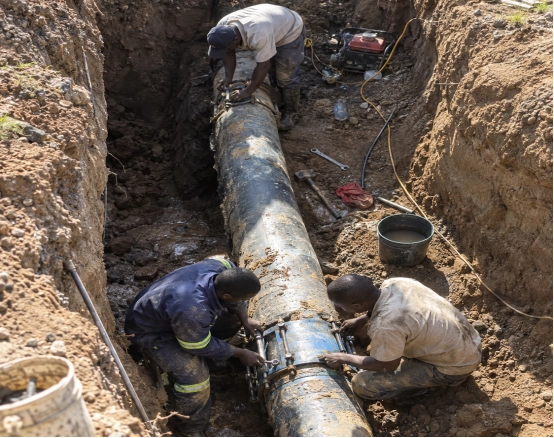
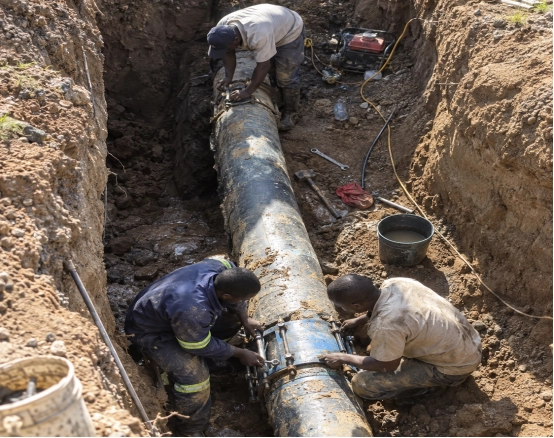
Nairobi is a useful place to examine the problem. The city has grown around a water network built in different periods.
The latest reports from Nairobi City Water and Sewerage Company and Kenya’s water regulator describe a familiar urban challenge: demand is rising while parts of the distribution system remain difficult to monitor and repair. Cities need better network data, sensible pressure control, quick repairs and connections that suit the pipe in front of the crew.
What Nairobi’s Pipeline Challenges Reveal About African Cities
Nairobi’s distribution system is not one uniform asset. A replacement project may bring a new PE line to an older ductile iron or steel main. Narrow streets and sections that cannot be shut down for long change the repair decision.
Repeated failures often occur at joints, bends, valves and service connections. Ground movement adds stress. Intermittent supply can create pressure swings. An emergency patch may hold for a while, then fail at the next weak point. The same pattern appears in Accra, Johannesburg, Kampala and other fast-growing cities.
Why Aging Pipeline Networks Lose So Much Water
Several causes overlap, which makes a single fix unreliable.
Hidden leaks and deteriorated joints
Corrosion, worn gaskets and damaged pipe walls can release water underground without a dramatic surface break. By the time damp soil appears, the leak may have affected a road base. Joint inspections and acoustic or pressure-based surveys help locate failures earlier.
Pressure fluctuations
Pumps, elevation changes and intermittent schedules expose old pipes to repeated pressure changes. A line that survives steady pressure may fail during a rapid restart. Pressure management reduces stress, yet settings must still deliver service to customers at higher ground.
Materiales mixtos de tuberías
A network assembled over decades rarely has one standard outside diameter. PE, PVC, ductile iron and steel behave differently under load. Connections need the right sealing range and, in some locations, resistance to axial movement.
Slow emergency response
When a utility must remove a long pipe section or wait for a rare fitting, water loss continues and traffic disruption grows. A field-ready repair method can change the outcome.
Five Practical Ways African Cities Can Reduce Water Loss
The strongest programmes connect field work with operating data. Each repair should improve the next repair decision.
- Identify high-risk pipe sections and establish priorities
- Use pressure management to prevent recurring failures
- Rapidly repair leaks without replacing entire pipe sections
- Improve connections between pipes of different materials
- Establish preventive maintenance and monitoring cycles
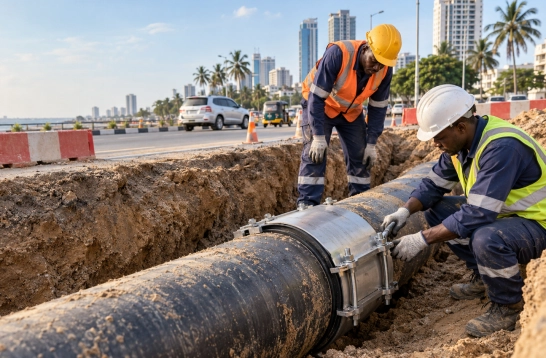
Localized damage does not always justify cutting out a long pipe length. A Utilice una camiseta de brida universal para ramas pequeñas a medianas, tuberías de varios materiales (DI, PVC, PE, acero), instalaciones rápidas y proyectos con tiempo de cierre limitado. can seal a crack, pinhole or corroded area when its size, pressure rating and gasket are suitable. Stainless-steel repair clamps and repair clamp connectors suit selected water-line conditions. Damage length, pipe ovality and working clearance matter.
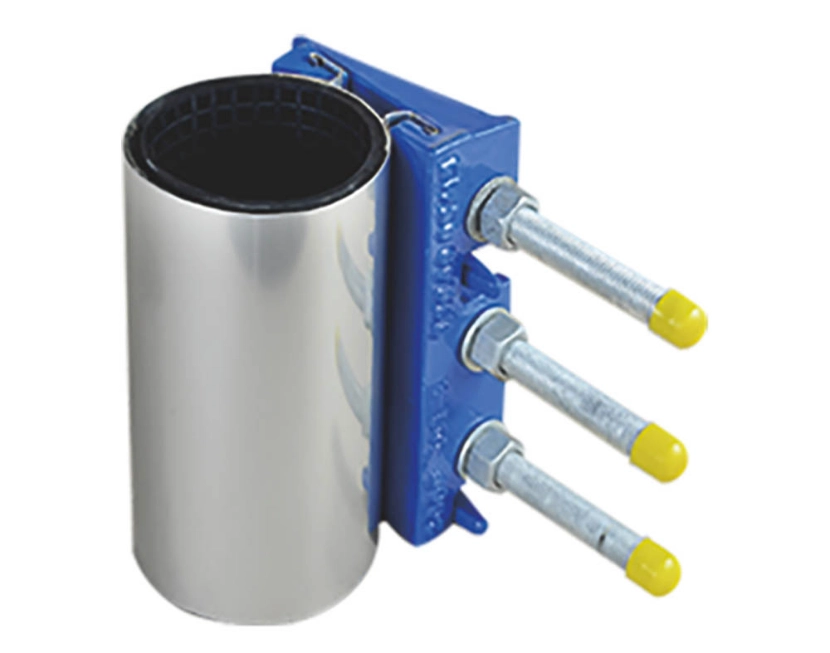
On a Nairobi street, a compact repair can mean one excavation and a shorter shutdown. It still requires isolation, cleaning, correct bolt tightening and a pressure test. Product selection should follow the manufacturer’s limits.
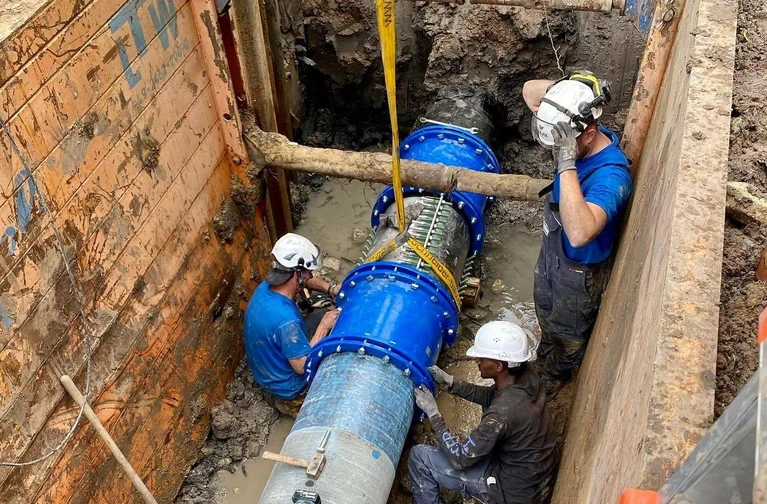
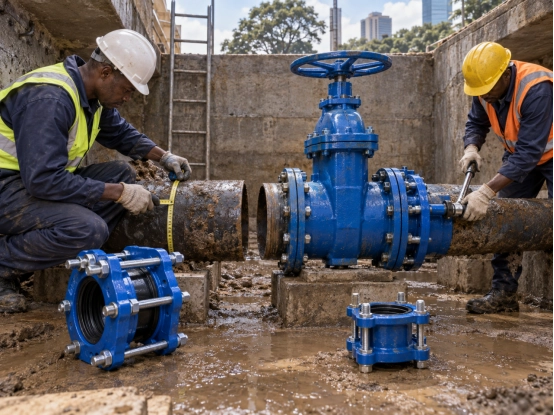
Replacement crews often face an old pipe on one side of the trench and a new PE or PVC pipe on the other. Acoplamientos universales y flange adapters can simplify that transition when measured outside diameters fall within range. Restrained versions may suit locations where pullout is a concern.
Alignment is critical. So are gasket compatibility, bolt sequence and surface preparation. A coupling can still leak if pipe ends are misaligned or the old barrel is badly pitted.
What Should Utilities Check Before Ordering Pipeline Repair Products?
The field measurement often decides whether a repair succeeds. Procurement teams and contractors should confirm:
- Nominal diameter and measured outside diameter
- Pipe material and remaining wall condition
- Operating pressure and temperature
- Water, oil, gas or another conveyed medium
- Damage type, width and length
- Required repair length
- Axial restraint or pullout requirements
- Corrosion and soil conditions
- Available installation clearance
- Applicable project or local standards
Photos help, but they do not replace measurements. Sending this information with a tender enquiry allows a manufacturer to check the sealing range, hardware and installation method before a crew is standing over an open trench.
How Conflex Supports Water Pipeline Repair and Connection Projects
Conflex manufactures pipe repair clamps, couplings, flange adapters, dismantling joints and flexible connection products for industrial and municipal pipeline work. The range includes solutions for PE, PVC, ductile iron and steel applications, subject to the specifications of each model.
For a localized failure, a stainless-steel repair clamp connector may be considered when the pipe condition and dimensions are suitable. For a material transition, a universal coupling or flange adapter can support a more practical connection. Flexible connections and rubber expansion joints can help accommodate movement or vibration in the right installation. These choices still depend on pressure, medium, diameter and site conditions.
FAQ: Reducing Water Loss in Aging Pipeline Networks
Q: What is the fastest way to reduce water loss from an old pipeline?
Start with high-loss zones and recurring burst locations. Leak detection, pressure checks and correctly selected repair clamps can reduce avoidable losses while a longer-term replacement programme is prepared.
Q: Can repair clamps be used on different types of water pipes?
Some clamps are designed for a particular material. Others cover a range of pipe types or outside diameters. The decision depends on diameter, pressure, damage type, sealing requirements and the product specification.
Q: When should a utility use a coupling instead of a repair clamp?
A repair clamp seals localized damage on an existing pipe wall. A coupling joins two pipe ends. If the pipe has been cut out, a coupling is usually the relevant connection. If the barrel is intact but leaking, a repair clamp may be more appropriate.
Conclusión
Nairobi’s experience points to a practical direction for African cities. Map the network. Control pressure. Repair the failure that is actually present. Use compatible connections when materials change. Keep the repair record useful.
Conflex can help utilities and contractors review pipeline repair clamps, couplings and flexible connection products against a specific site condition. The next step is simple: provide the pipe material, measured diameter, pressure, conveyed medium and damage details for a technical discussion.

 Spanish
  English
  Arabic
  Chinese
  French
  German
  Indonesian
  Italian
  Kazakh
  Kyrgyz
  Portuguese
  Russian
  Swahili
  Uzbek
Uzbek