





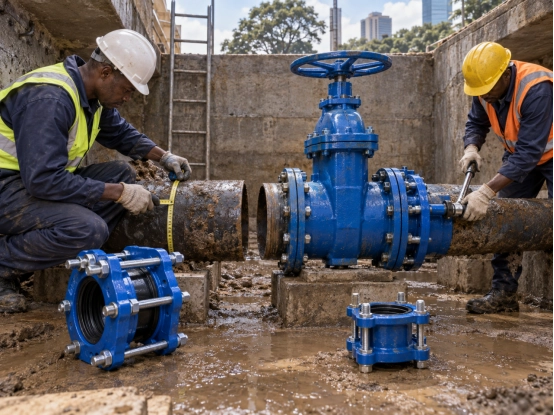
A valve chamber looks simple on a drawing: two pipe runs, one valve, enough space for an operator. On site, it is rarely that neat.
In Nairobi, crews may enter a wet chamber with corroded bolts and little room to move a heavy valve. It may be isolated and unbolted yet remain trapped between fixed flanges. A dismantling joint adds controlled axial movement beside the valve. That allowance can turn a difficult shutdown into routine work.
What Makes Valve Chamber Maintenance Difficult in Nairobi?
Access is only part of the problem. The internal layout decides whether a valve can be removed.
Limited Working and Removal Space
Many chambers provide enough space for installation but not replacement. A technician removes the bolts, disconnects the actuator, attaches lifting equipment—and the valve still cannot move.
Even 30 mm of missing clearance can stop the work. Creating that space with grinders and lifting gear inside a damp chamber is slow and awkward. Around large butterfly valves, it may also be unsafe.
Aging Components and Mixed Pipeline Configurations
Nairobi’s network has been extended and repaired in stages. One chamber may combine old steel pipe, ductile iron fittings, a newer valve, and different flange drilling.
Settlement adds variation. Supports move. Flanges no longer sit square. A replacement valve may have the correct diameter and pressure class but a different face to face length. On paper, it fits. In the chamber, it may be 20 mm too long.
That is enough to turn a valve change into a pipe modification job.
Why Do Rigid Flanged Connections Make Valve Replacement More Disruptive?
A rigid flanged assembly gives almost no tolerance. Once both pipe ends are fixed, every component between them must match the available length closely.
Without a dismantling joint, crews may cut an adjacent spool or remove another fitting just to release one valve. The pipework then has to be realigned, reconnected, recoated, and pressure tested.
Pulling misaligned flanges together with bolts is not a solution. It loads the valve body and may compress the gasket unevenly.
How Does a Dismantling Joint Make Valve Maintenance Easier?
The useful movement is along the pipe axis, exactly where a flanged valve assembly needs clearance.
It Creates Adjustable Axial Clearance
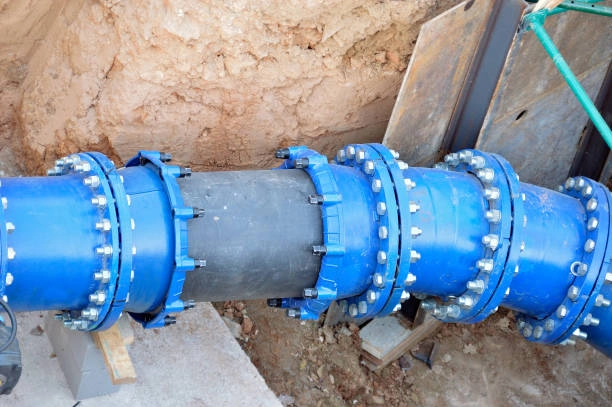
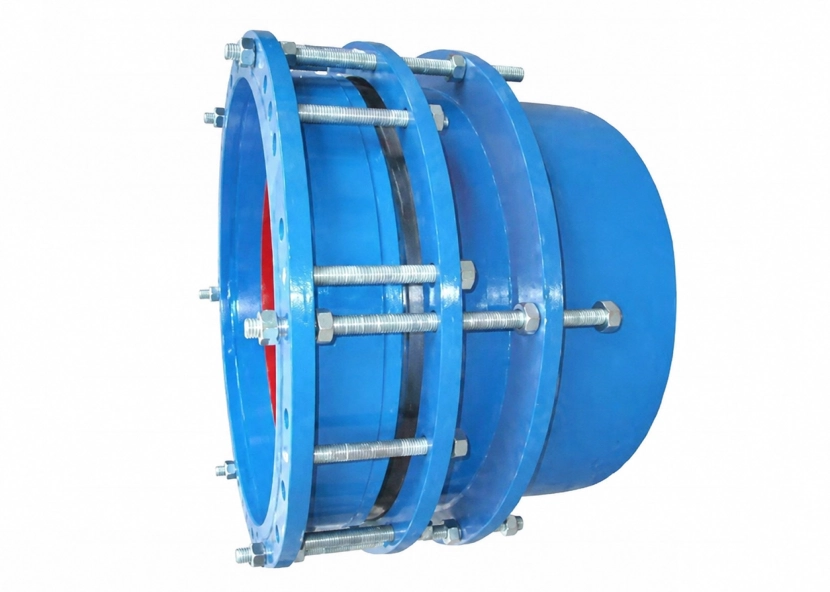
A dismantling joint uses a telescopic arrangement between flanged sections. During maintenance, the restraining system is loosened and the joint is shortened within its designed range.
This creates a gap between flange faces. The valve can then be lifted out without cutting the pipe.
A common arrangement places the joint directly beside a butterfly valve: one controls flow, the other provides removal space.
It Compensates for Installation Tolerances
Civil works and pipe fabrication are never exact to the millimetre. A dismantling joint can absorb reasonable axial variation.
This helps when an old valve is replaced by a model with a slightly different body length. Instead of fabricating a special spool, the joint can often close the gap.
Minor flange position differences may also be accommodated. Serious angular or lateral misalignment still needs proper correction.
Tie Rods Restrain Pressure Forces
A dismantling joint is not an unrestrained sliding sleeve. Internal pressure creates axial thrust near valves, bends, reducers, and closed ends.
Full length tie rods restrain the assembly after adjustment. The joint does not replace supports or thrust restraint. A valve still needs independent support.
How Should Engineers Select a Dismantling Joint for a Nairobi Valve Chamber?
Selection should begin with field measurements, not only record drawings. Older chambers often differ from drawings.
Match Diameter, Pressure Rating, and Flange Standard
Confirm nominal diameter, flange outside diameter, bolt hole pattern, pressure class, available length, and adjustment range.
PN16 is common in water systems, but it should not be assumed. Operating, surge, and test pressures all matter. A connection near a pumping station may face different loads from one on a gravity fed line.
The joint also needs space for tie rods, tools, and future retraction.
Choose Materials for Water and Chamber Conditions
Ductile iron and fabricated steel are both common. The choice depends on diameter, pressure, specifications, and coating requirements.
For potable water, gasket and coating approvals matter. EPDM is commonly used for water service. Fasteners also deserve attention because chambers remain damp.
Conflex offers dismantling joints in several diameters, pressure classes, flange standards, gasket materials, and coating options. That range can help when new fittings must match mixed existing infrastructure, though the final choice should follow project drawings and hydraulic requirements.
Verify Restraint, Access, and Installation Requirements
Check that the tie rods are accessible and that the joint can retract without hitting a wall, ladder, actuator, or pipe support.
Bolts should be tightened in a cross pattern, with gaskets seated evenly and the valve independently supported.
A joint that fits hydraulically but cannot be adjusted by a technician is not maintainable.
When Should Dismantling Joints Be Added to Valve Chambers?
They should be considered during new chamber construction, valve replacement, meter installation, pressure reducing station upgrades, and major pipeline rehabilitation.
Likely candidates include butterfly valves, control valves, check valves, strainers, bulk meters, and pump connections.
The best location is beside the removable equipment, with enough straight length and working clearance. Installing the joint against a chamber wall defeats its purpose.
Conclusion
The main gain is predictability.
A valve replacement can remain a valve replacement instead of becoming a cutting, welding, coating, and civil repair exercise. Shutdown windows are easier to estimate. Fewer tools are needed inside the chamber. Adjacent pipework is disturbed less.
Straightforward access also makes delayed maintenance less likely.
Dismantling joints will not solve leakage or non-revenue water by themselves. They make critical equipment easier to service. That is narrower, but still useful.
Valve chambers should not be designed only for commissioning day.
In Nairobi, where shutdowns can affect dense service areas and site access is difficult, a small amount of planned axial movement makes a noticeable difference. A restrained dismantling joint provides that movement. No complicated mechanism. Just space where space is needed.
FAQ
Q: Where should a dismantling joint be installed?
Usually beside the valve, meter, or fitting that may need removal. Enough room must remain for retraction.
Q: Can a dismantling joint correct pipe misalignment?
It can accommodate limited axial variation, not serious angular, lateral, or rotational misalignment.
Q: Is a dismantling joint suitable for PN16 water pipelines?
Yes, when it is rated for PN16 and the design confirms that PN16 suits operating, surge, and test pressures.
Q: Does the valve still need separate support?
Yes. Heavy valves and fittings should be supported independently.
Q: Can dismantling joints be retrofitted in existing Nairobi chambers?
Yes, but length, flange pattern, pressure class, support arrangement, tool access, and retraction space must be checked.



 English
  Arabic
  Chinese
  French
  German
  Indonesian
  Italian
  Kazakh
  Kyrgyz
  Portuguese
  Russian
  Spanish
  Swahili
  Uzbek
Uzbek