




Mexico City’s water network operates in difficult ground. Large areas sit on compressible former lakebed soils, while groundwater extraction continues to drive settlement. The ground does not sink as one solid mass. One street or utility trench may move faster than the next.
The visible symptom is usually a leak. The engineering problem is differential movement.
Why Are Mexico City’s Water Pipelines So Vulnerable to Land Subsidence?
Removing groundwater allows clay rich layers to compact. Pipes settle with the trench—unless part of the route is supported by firmer ground, a structure, or older backfill.
A pipe can sometimes follow gradual, uniform settlement. Differential settlement creates curvature. It bends the barrel, pulls joints apart, and rotates connections beyond their allowable angle.
How Does Subsidence Physically Damage Buried Water Pipelines?
Material, joint type, pressure, and corrosion condition shape the failure. Several mechanisms often overlap.
When soil support drops away, the pipe acts like a beam. Cast iron may crack with little deformation. Steel bends farther, but corrosion pits become weak points. PVC may deflect or split where embedment support is uneven.
The break may occur beside the largest void. A short rigid replacement can shift the next failure to its edge.
Axial movement can reduce socket insertion or pull pipe ends from a coupling. Angular movement compresses one side of a gasket while opening a leak path on the other.
What Warning Signs Indicate Subsidence Related Pipeline Damage?
Repeated leaks on the same street are the clearest warning. Also watch for uneven joint gaps, angular offset, displaced gaskets, wet pavement, settling patches, and depressions around valve boxes.
Rising minimum night flow, unexplained pressure loss, or recurring low pressure complaints may indicate hidden leakage.
A repair that fails again after a few months is not bad luck. Ask not only, “Where is the leak?” but, “What is the pipe trying to do?”
Which Products Best Match Each Subsidence Related Failure Mode?
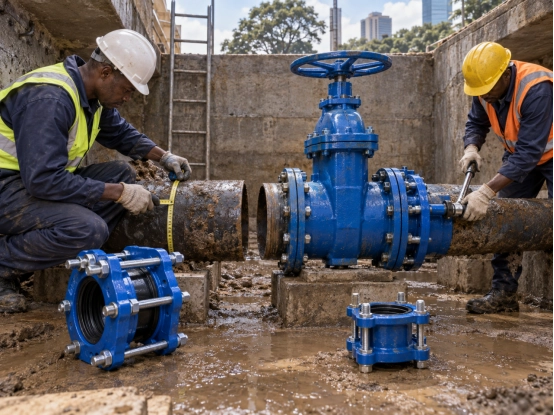
The product should match the movement mechanism. A clamp seals a local defect. A coupling reconnects pipe ends and accommodates limited displacement. An expansion joint handles controlled movement in engineered flanged pipework.
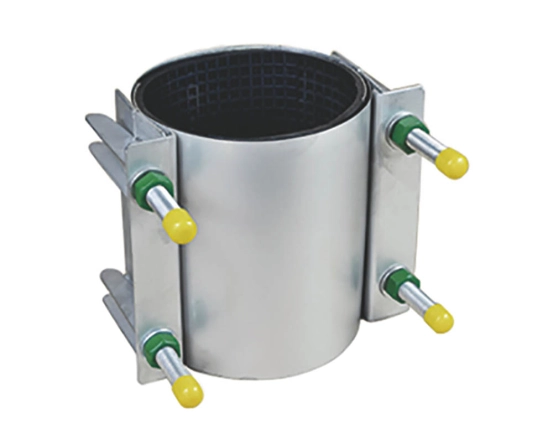
A stainless steel repair clamp suits a structurally serviceable pipe with a localized corrosion hole, short crack, pinhole cluster, or limited split.
Conflex’s FCE Stainless Steel Connect Repair Clamp wraps the damage and compresses a gasket around the pipe without removing a long section. On a congested street, less cutting means fewer alignment changes and a shorter shutdown.
CR-2 Stainless Steel Band Repair Clamp may suit wider damage when its diameter, pressure, gasket, and damage length limits match the site. Neither clamp should bridge a separated or rotating joint.
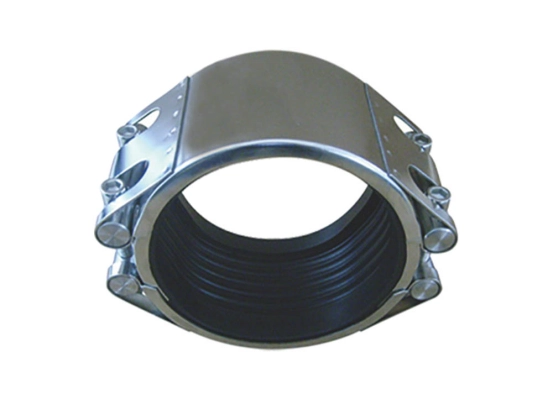
When pipe ends must be reconnected, a restrained universal coupling is usually more appropriate than a patch, especially where diameters or materials differ.
Restrained Universal Coupling provides limited angular deviation and telescopic adjustment, helping crews connect ends that are no longer perfectly aligned. Its restraint system also addresses axial pullout.
Those allowances are limits, not targets. A joint installed near maximum deviation has little capacity left for future settlement.
How Should Engineers Select and Install the Correct Repair Solution?
The fitting is only part of the repair. Measurement, excavation stability, support, and bolt control often decide whether it lasts.
Confirm the Actual Pipe and Operating Conditions
Use the measured outside diameter, not only the nominal size shown on an old drawing. Confirm pipe material, surface condition, working and surge pressure, temperature, and potable water requirements.
Measure crack length, joint gap, angular offset, and clearance. Identify whether movement is axial, radial, rotational, or combined. Old pipes may be out of round, so clean the sealing area before final selection.
Avoid Locking Existing Stress Into the Repaired Pipeline
Expose enough pipe to understand the alignment. Stabilize the excavation, rebuild lost bedding, and realign only within safe limits.
Tighten bolts gradually and evenly. Uneven torque can distort the gasket or pull the fitting off center. Record the installed gap and angle where movement may continue.
If the correction exceeds the fitting’s capacity, change the pipe profile, improve support, or replace a longer section. Forcing the connection closed only stores the next failure.
What Results Can a Flexible Pipeline Repair Strategy Deliver?
A movement aware repair can restore service with less excavation than full replacement and reduce stress where materials or diameters change. Flexible products do not stop subsidence. They allow a measured amount of rotation, adjustment, or axial load without immediately reopening the joint.
On a busy road, that may mean one controlled excavation instead of repeated emergency patches. A clamp on a moving joint, or a coupling beyond its allowable deviation, merely postpones the problem.
Core Conclusion: Select Pipeline Repair Fittings Based on Subsidence Displacement Mode Instead of Single Leak Location
Differential land subsidence creates continuous bending deformation on buried water main barrels, pulls apart socket pipe joints, destroys EPDM sealing gaskets, and washes away pipeline supporting bedding backfill.
For minor localized pipe wall defects including pinholes and short cracks, stainless steel repair clamps are the optimal sealing solution; severely misaligned or fully separated pipe ends require restrained universal couplings with multi-directional displacement compensation capacity; flange connections near pumps and mechanical equipment adopt dedicated rubber expansion joints.
Field municipal engineers must analyze the subsidence-induced pipeline displacement trend first to select matching stainless steel repair fittings, rather than adopting random on-site repair clamps without professional matching. This standardized matching strategy effectively reduces repeated emergency leakage maintenance for long-term municipal water network operation.
FAQ
Q: Can a repair clamp stop damage caused by land subsidence?
It can seal a localized crack or hole, but it cannot stop ground movement. A moving or separated joint may also require support correction or a suitable coupling.
Q: How much misalignment can a flexible coupling accept?
The allowable angle and axial adjustment depend on the model and pipe size. Field measurements should remain inside published limits, with capacity left for future movement.
Q: Should a leaking pipe be realigned before installing a coupling?
Usually, but only within safe limits. Forcing a displaced pipe into line can lock stress into the repair.
Q: Are rubber expansion joints suitable for buried water mains?
They are more common in engineered flanged systems near pumps and equipment. Buried applications need specific restraint, access, and protection.
Q: What information is needed to select a repair product?
Provide measured pipe outside diameter, material, pressure, damage type, crack length or joint gap, angular offset, expected movement, and clear photos.


 English
  Arabic
  Chinese
  French
  German
  Indonesian
  Italian
  Kazakh
  Kyrgyz
  Portuguese
  Russian
  Spanish
  Swahili
  Uzbek
Uzbek